Thursday, January 2, 2014

MODI'S SUCCESS IS IN RECOGNIZING AND RESPONDING TO THREE INTERTWINED NEEDS, NEED FOR UNIFORM DEVELOPMENT ALL ACROSS INDIA INCLUDING AGRICULTURAL SECTION, NEED TO ENHANCE COMMUNICATION WITH AND NURTURING, EMPLOYING AND UNITING OF THE YOUTH, DAMAGE CONTROL OF DIVIDE AND RULE POLITICS OF THE BRITISH AND THE CONGRESS-UPA GOVERNMENT ALL USING MODERN IT INFRASTRUCTURE, MODI TO REACH THE GRASSROOTS AND THE 70% RURAL POPULATION AND THE POOR OF INDIA BY OPPOSING CORRUPTION MORE VEHEMENTLY AND WIDELY THAN AAM ADMI PARTY

The rise and rise of Narendra Modi
by Naagesh Padmanabanon 03 Jan 20141 Comment

The electronic and print media in India have consistently projected a perverse and dismal image of the Gujarat chief minister Narendra Modi, notwithstanding the fact that he has been unequivocally cleared of any wrongdoing by a special investigating team (SIT) appointed by the Supreme Court of India. Its findings have now been accepted by the metropolitan magistrate’s court in Ahmedabad on December 26, 2013.

In the midst of this polarization, manufactured by a very powerful section of the electronic and print media, a well informed and intelligent discussion has become next to impossible. Nevertheless, this writer wishes to highlight some key issues that have not been widely discussed by mainstream political pundits.

India is witness to a huge transformation that is sweeping the country as a result of three simultaneously occurring and evolving phenomena. This transformation will influence the future course of events in India and will in due course determine who the next prime minister will be, and also impact decisions beyond 2014.

Narendra Modi has fully understood these forces and has used them to his advantage. This has paid him handsome dividends already - as seen from the massive following that his rallies evoke, and the stunning success in the recently concluded regional elections (Rajasthan, Madhya Pradesh, Chhattisgarh, and partially Delhi). These three forces are the peoples’ expectations to deliver on development, India’s ‘demographic dividend’, and the skillful deployment of technology and internet - specifically social media, in governance and mobilizing the people. Let us elaborate.

Many so called pundits have us believe that invoking development as an election plank is a new phenomenon. They accuse Narendra Modi of starting a new expectation cycle from the people on economic development. This is far from the truth. 

For six long decades, Nehruvian-socialist shibboleths have been peddled as the panacea for removing poverty. But keen observers have always been aware that political parties – all of them – have been guilty of keeping large sections of society poor and underprivileged. Their logic was that these sections were susceptible to enticements and could be won over with trinkets, gifts and cash disbursals that came in handy to win elections. This, arguably though, is one of the reasons why we find slums dwellers in every city across India. That this has become an uncontrollable eye-sore is another matter.

To cover up incompetent governance and rank corruption, they raised a host of phony issues engendering what Nehru would have called ‘fissiparous’ policies, such as appeasement politics that do not have real mass approval and ultimately end up against India’s interests. Today there is widespread anger and demand for governance from every section of society.  Narendra Modi has shown the courage to change the narrative from rigmarole sloganeering to execution and good governance at the grassroots. What Modi has done in Gujarat is not unique; he delivered what a reasonable leader in a democracy is expected to deliver and his government performed the duties expected of it. The time has come where anyone with a good record of governance can win the heart of India. This expectation has taken deep roots and the Gujarat chief minister has positioned himself at the right place at the right time to encash his good work.

Secondly, the Indian political class today mainly comprises a group of senior citizens desperately clinging to office and privilege. With over 65% of Indians below the age of 35, this gerontocracy has long lost its’ connect with people. Overwhelming incompetence and corruption have accentuated this disconnect. However, the youthful demographic segment has played a very significant role in independent India in rousing and influencing public opinion on a range of issues that have shaped the national discourse in recent times, from the gang-rape in Delhi in 2012, to exposing a media personality’s sexual indiscretions, to drumming up support for a transparent administration.

Narendra Modi has smartly influenced this segment by showcasing his record of governance in Gujarat and offering the ‘India First’ theme to transcend sectarian allegiances. The Gujarat government’s efficient delivery of basic service to the people of the state and the attendant transparency has attracted millions to his fold. From there on, he has shown superb leadership in keeping this burgeoning following by reporting to them at huge rallies the accomplishments in Gujarat and his dreams for India. This has captivated the under-35’s as well as larger sections of the middle class.

Thirdly, Modi is tech savvy and has not shied away from using IT to enable development. He has an overwhelming following on Twitter – over 3 million followers. His YouTube videos are a big hit. He is creatively engaging this group by crowd-sourcing new ideas for the 2014 election. The India272 website is an outstanding example where he has requested his fans to suggest campaign slogans, new ideas for development and electioneering. On the contrary, the UPA regime and other parties have not only not courted them, but angered them by censoring social media. Winning the hearts of this massive segment is the biggest win for Modi and his party.

Modi has definitely won the hearts of the people in his fight to capture Delhi. He is the hot favorite to become prime minister. However, it would be naïve to conclude that the battle is won. There are any number of inimical forces determined to keep him from taking charge of India. These are both internal and external forces that are working in tandem to stop him in his tracks. These forces will mount as many challenges as possible – legal, constitutional, political etc to block him. So his path to Delhi is not exactly a bed of roses and he is fully aware of it.

What is most heartening, however, is that he has awakened an India that was long suppressed and emasculated by a perverted political model that defied logic for over six decades. If the British divided and conquered India, the Nehruvian socialists perfected the art of appeasement to further splinter India. Both have greatly damaged the soul of India, but have not succeeded in destroying India. Narendra Modi will have his hands full in cleaning up the mess in 2014.

The author is a finance industry professional; he lives in Philadelphia

Courtesy: Vijayvaani.com and Kalyan97

User CommentsPost a Comment
But a new threat has emerged in the form of proxies and activists with impossible populist agendas-- like Arvind Kejriwal and his Aam Admi Party. His program has two aspects-- a repackaged Nehruvian socialist agenda, even Communist, as Karat claimed and a front and a new face to cover the jaded Congress whose leaders have no credibility left..

It is old agenda on a new platter with a new face.
N.S. Rajaram
5 Hours ago

SEQUEL TO OBFUSCATION OF JAMMU-KASHMIR ISSUE: CHINA'S INTEREST IN SHAKSGAM VALLEY

Geopolitics

China’s Interests in Shaksgam Valley
IssueNet Edition| Date : 11 Oct , 2013
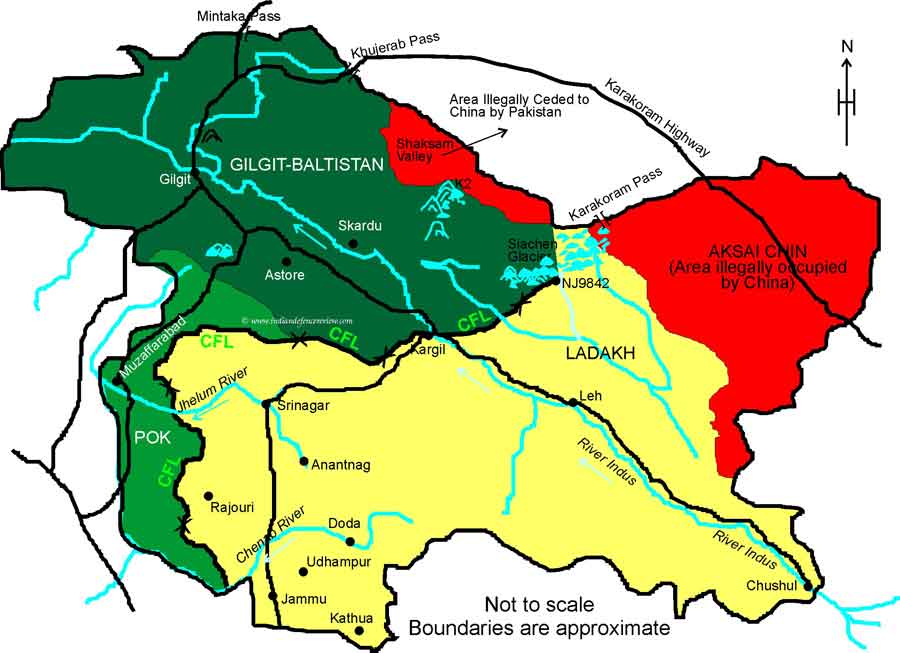
Chinese nationals are once again in the newspapers of Gilgit-Baltistan, this time for smuggling heavy precious metals and gems out of the region.
To date, China occupies more than 20,000 square kilometer of Gilgit-Baltistan covering Shaksgam, Raskam and Aghil valleys.
Similar reports also appeared last year when they tried to smuggle uranium, gold and copper from Gilgit-Baltistan. The Chinese model of mineral exploration fails to support Gilgit-Baltistan’s economy since the corporations do not provide jobs to the locals and deny a share in the revenue to the resource-owners.
To make the situation worse, the Pakistani regime has placed a ten-year ban on local businesses involved in gem extraction and trade. Undue concessions to the international corporations and ban on the locals affect the economic well-being of tens of thousands of people.
Pakistani regimes are notoriously famous for bending over backwards to facilitate China’s involvement in Gilgit-Baltistan.
In 1963, Pakistan handed over 5,800 square kilometers of the territory of Gilgit-Baltistan to China without the consent of the local people. Authorities even threatened the ruler of Hunza, who claimed the valleys up to the Aghil Pass, of imprisonment and torture for objecting to such a deal. China currently occupies more than 20,000 square kilometer of Gilgit-Baltistan covering Shaksgam, Raskam and Aghil valleys.
The Communist Party of China might find it interesting that the Chinese official maps of 1917, 1919 and 1933 recognize the border of Jammu & Kashmir at the Kunlun mountain range. An earlier map of Xinjiang compiled in 1762 at the orders of the Chinese Emperor Chien Lung also acknowledged the southern border of Xinjiang at Kunlun. This comfortably places Shaksgam, Raskam and Aghil valleys within Gilgit-Baltistan.
The majority of the geographical entities in both the Aghil and Shaksgam valleys possess Balti nomenclature demonstrating an ancient socio-economic and political interlinks of these valleys with Baltistan.
For instance, the passes are called Sarpo Lago (yellow top of the pass), Drenmang La (abundant with bears), Shingshol La (pass where tree density is thinning) and Sagang La (pass with earth and ice).
China has built feeder roads eastward through Shaksgam linking Gilgit with Hotan, which is an important military headquarter situated at the cross-section of the Tibet-Xinjiang Highway and Hotan-Golmud Highway.
The mountains are named Skyang Kangri (wild donkey), Kyagar Kangri (grey and white) and Skamri (dry rock), while the valleys are Shaksgam (dried up heap of pebbles), Aghil Ldepsang (plain), Marpo Lungpa (red), Salungma (earthen), Khapulung (gateway valley), Kharkhor Lungma (castle surrounding) and Skam Lungpa (dry).
The famous camping grounds include Moni Brangsa (residence of musicians), Balti Brangsa (Balti residence) and Balti Pulo (dwellings of the Baltis).
According to the local historians, the Raja of Shigar established a polo-ground south of the Shaksgam valley in the 5th Century AD. The ground, called Muztaghi Shagaran, the polo-ground of ice-peak,attracted fanfare with players and musicians when the autumn harvest festival was celebrated.
The musicians who accompanied the royal entourage established camps at Moni Brangsa, the residence of the musicians, near the lower reaches of the Sarpo Lago River. It was at this shagaranthat the rulers of Shigar and Hotan played polo matches on yearly basis and reviewed their diplomatic relations.
The occupation of these valleys came in the wake of Pakistan and China forming a strategic alliance, which enabled both countries to counter their economic and political adversaries.
As part of the frontier settlement plan, both nations, represented by Pakistani Foreign Minister Zulfikar Ali Bhutto and Chinese Foreign Minister Chen Yi, signed a provisional agreement on March 2, 1963 in Beijing allowing China to occupy Shaksgam, Raskam, Shimshal and Aghil valleys of the disputed territory of Gilgit-Baltistan.
As part of the deal,
“the two parties agreed that after the settlement of the Kashmir dispute between Pakistan and India, the sovereign authority concerned will reopen negotiations with the government of the peoples’ republic of China on the boundary, as described in Article II of the present agreement of Kashmir, so as to sign a boundary treaty to replace the present agreement.”
India protested the matter with China, and registered its concerns with the United Nations. The Chinese authorities guaranteed India that it accepted Gilgit-Baltistan as a disputed territory and that the agreement was only provisional in nature and would be renegotiated once the dispute of Jammu & Kashmir was resolved.
Today, not just Shaksgam, Aghil and Raskam, but the entire Gilgit-Baltistan has been placed at China’s disposal.
Since then, China has built feeder roads eastward through Shaksgam linking Gilgit with Hotan, which is an important military headquarter situated at the cross-section of the Tibet-Xinjiang Highway and Hotan-Golmud Highway.
The Hotan-Golmud Highway links Xinjiang to Qinghai province and central China. It reduces the distance between Gilgit and Golmud to almost half, while bypassing the longer Urumuqi-Kashgar Highway.
Golmud is a strategically located booming city and functions as one of the largest goods transit point in western China. It is the strategic military headquarter of west China, the national petrochemical base, and home to rich oil wells and minerals.
Likewise, the feeder stretching along the southern rim of East Turkestan connects Gilgit with Aksai-chin and cuts the distance between both regions by more than 800 miles. China’s ability to control the northern valleys of Gilgit-Baltistan has helped connect military and industrial complexes of North-Western Tibet to Pakistani and Persian ports.
Reports in local newspapers have emerged of China leasing Gilgit-Baltistan for 50 years. It is because of China’s influence that Pakistani authorities have to think twice before letting Western officials in Gilgit-Baltistan.
In the past, Gilgit-Baltistan politicians have been charged for sedition and local officials have been suspended from their jobs for entertaining US officials. This occurs despite millions in aid sent by the United States each year to Gilgit-Baltistan.
Now China is spending another US $18 billion to construct a 200 kilometer long tunnel in Gilgit-Baltistan which will help run rail service between Kashgar and Gwadar port in occupied Balochistan. The agreement was signed by Pakistani Prime Minister Nawaz Sharif, who has also agreed to establish China led industrial zones along the Karakoram Highway and laying fiber optic across the Karakoram Mountains.
Local politicians challenge such agreements and transfer of land to China because China and Pakistan do not have sovereign rights over Gilgit-Baltistan. They demand absolute autonomy and reinstatement of State Subject Rule to ensure socioeconomic security in Gilgit-Baltistan.
Birjees Tahir, the Federal Minister for Kashmir Affairs and Gilgit-Baltistan, stated that “Gilgit-Baltistan is a disputed area and a province like structure has been created only to improve local governance and decision making power. Gilgit-Baltistan cannot be merged with Pakistan until the resolution of Kashmir issue.”
…local institutions have no right over decision making and implementing laws, and the Minister of Kashmir Affairs is an absolute authority, who governs Gilgit-Baltistan like a viceroy.
However the fact remains that local institutions have no right over decision making and implementing laws, and the Minister of Kashmir Affairs is an absolute authority, who governs Gilgit-Baltistan like a viceroy.
Locals claim that the Chinese-Pakistani alliance is gaining legitimacy at the cost of the rights and assets of the people of Gilgit-Baltistan. They believe that the UN granted Pakistan temporary control over Gilgit-Baltistan which was possible only after granting complete autonomy to its residents.
However, Pakistan has failed to keep its promises.
Islamabad is violating the United Nations Declaration on the Rights of Indigenous Peoples by ignoring the legal standards of free, informed and prior consent of the natives to initiate resource extraction and trade and industrial build up. Prime Minister Sharif denied Gilgit-Baltistan a representation during the preparation and execution of agreements with his Chinese counterpart in Beijing.
http://www.lancerpublishers.com/catalog/product_info.php?products_id=1231
Click to buy
China’s undue involvement in the disputed area of Gilgit-Baltistan complicates and prolongs the controversy over Kashmir with socioeconomic, cultural and political implications and enhanced vulnerability in an ecologically fragile area. If not understood, it will have irreparable military and strategic implications for all of South Asia.
Rate this Article
Share

About the Author

Senge H. Sering
Senge H. Sering is president of the Washington D.C. based Institute for Gilgit Baltistan Studies and hails from Baltistan
More by the same author

USE MODERN TECHNOLOGY AND NETWORKING TO WIN ELECTION FOR MODI AND BJP, EACH NRI CAN CALL 30 FRIENDS IN INDIA AND REQUEST THEY CALL 30 MORE EACH REQUESTED TO CALL 30 MORE AND SO ON TO EXPONENTIALLY PROMOTE MODI : INDIA 272 + IS A MUST

Narendra Modi launches mobile application called 'India272+'
HT correspondent, Hindustan Times
Ahmedabad, January 03, 2014
First Published: 00:10 IST(3/1/2014)
Last Updated: 00:34 IST(3/1/2014)
In a bid to consolidate the mandate received in the recent state assembly elections and achieve the magic figure of 272 in the upcoming Lok Sabha polls, BJP's Prime Ministerial candidate Narendra Modi launched 
a mobile application called 'India272+'.
According to Modi's website, the application is available on the Google Play Store and can be downloaded for free by Android users.
The application, which was launched yesterday, seeks to take BJP's Mission 272+ to a wide range of volunteers across the country.
The mobile application enables volunteers to participate in open fora and share thoughts, ideas for upcoming speeches by Modi.
The application allows volunteers to share latest updates through social media including Facebook and Twitter as well as smartphone applications like WhatsApp.
"Launched India 272+ mobile app. the app will further empower volunteers to contribute easily, effectively and creatively," Modi tweeted.
While launching the mobile application, Modi expressed confidence that it would go a long way in not only strengthening the bond between existing volunteers, but would also draw more volunteers to the India272+ platform.
Modi welcomed the innovative use of technology in expanding the larger BJP family and seeking the contribution of the volunteers.
Earlier, a website India272.com was launched before the recent assembly polls in the five states.

 0  456  101  610
- See more at: http://www.hindustantimes.com/news-feed/india/narendra-modi-launches-mobile-application-called-india272/article1-1168791.aspx#sthash.nScYEVqw.dpuf